
Pasco Parole and Probation Differences
A Pasco County jail release does not, by itself, identify the order that follows. Probation is imposed by a judge and is usually supervised by Florida Department of Corrections Community Corrections. A person can receive probation after jail, after a prison term, or without a prison term. Parole is a discretionary prison release administered by the Florida Commission on Offender Review, or FCOR, for a limited legacy-eligible population. Conditional release is another Commission-linked form of supervision created by statute. It should not be called parole merely because both follow prison custody.
The signed Pasco County sentencing order establishes the court’s terms. The current FDC supervised-population record shows whether state supervision is active and can identify an assigned office. For parole or conditional release, FCOR material may also show Commission action. The comparison keeps those sources in their proper roles.
| Supervision type | Who orders it | Best verification source |
|---|---|---|
| Probation | Criminal court | Pasco Clerk sentence plus FDC supervised-population record |
| Parole | Florida Commission on Offender Review | FCOR order, schedule, or records response plus FDC supervision record |
| Conditional release | Statutory and Commission process | FCOR decision and FDC current supervision detail |
| County or non-FDC supervision | Court or another named authority | Sentencing order and the office named in that order |
- Discharge
- The formal end of a supervision term.
- Absconder
- A supervised person reported unavailable for supervision and subject to retaking action.
- Revocation
- An order ending release status after the responsible authority finds a violation.
- DC number
- Florida corrections identifier used to distinguish people with similar names.
Verify Pasco County Supervision
The official sequence starts with the person, not the nearest office. FDC separates its public searches by category. A released-inmate record confirms a past state-prison event, while the supervised-population search addresses active state supervision. Searching only the jail’s Past Arrests archive can confirm that Pasco Corrections stopped holding someone, but it cannot settle the current parole or probation assignment.
- Collect the full name, date of birth, and DC number if known. Match more than a name.
- Open the FDC Supervised Population Search. Search by DC number when possible, or use name fields and identity details.
- Open the matching detail. Read status, supervision type, and the office or location shown on the current record.
- Use the FDC Circuit 6 office directory to verify the address and phone for that assignment.
- Search the Pasco Clerk court record for the signed sentence, later modification, violation filing, warrant, or discharge order.
- When parole or conditional release applies, compare the current FDC detail with FCOR’s order or public-record response.
The manifest image below comes from the official FDC supervised-population search.
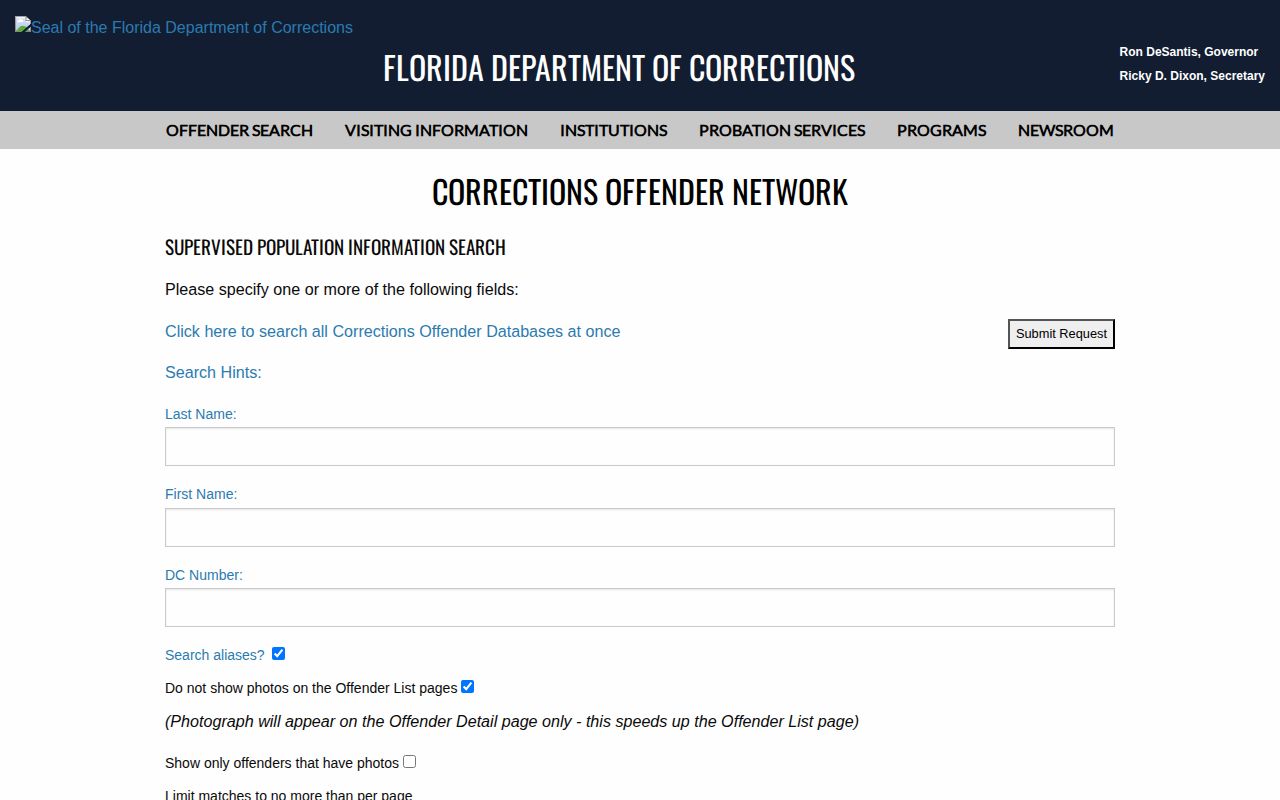
That category is the correct public starting point for an active FDC supervision question. It does not replace the Pasco County sentence that created probation.
Pasco Probation Office Assignments
Pasco County is served through FDC Circuit 6, but geography alone does not select a reporting office. The current supervised record may point to Dade City, Hudson, New Port Richey, or the Pinellas/Pasco intake office. Specialized caseloads can also affect assignment. A person should rely on the sentencing papers, officer instructions, and office shown in the live record rather than reporting to whichever building seems closest.
Three Pasco-area offices are named in the Circuit 6 directory. Office 063 is at 14450 7th Street in Dade City and publishes (352) 521-1214. Hudson Office 06E is listed at 7625 Little Road, Suite 100-A, New Port Richey, with (727) 861-5200. New Port Richey Office 062 is at 7619 Little Road, Suite C150, with (727) 841-4131. FDC Community Corrections also publishes (850) 717-3444 and co-supervision@fdc.myflorida.com for directory or status escalation.
Use the office on the person’s current supervised-population record.
State directory assistance: (850) 717-3444
Email: co-supervision@fdc.myflorida.com
Office assignments can change. Verify the current directory before travel, and do not treat an old address in a saved search result as a standing instruction.
Note: The assigned officer and current record control even when another FDC office is closer to the person’s home.
Pasco Supervision Warrants and Absconders
An absconder label is not a routine release status. It means the supervision authority reports that the person failed to remain available under supervision and is wanted or subject to retaking. FDC therefore places absconder and fugitive records in a search category separate from the ordinary supervised population. When an older supervision result no longer appears active, that second category can explain the change. The Pasco Sheriff active-warrant channel and the court docket may add local context.
Start with the FDC Absconder/Fugitive Search. Then review the Pasco Sheriff active-warrant page and the issuing court record when reliable facts point to a local warrant. Confirm the name, date of birth, DC number, case number, and issuing authority. Do not infer an active warrant merely from a missed appointment, an old news item, or a blank current-supervision result.
The official absconder search is shown in the matching FDC source image.
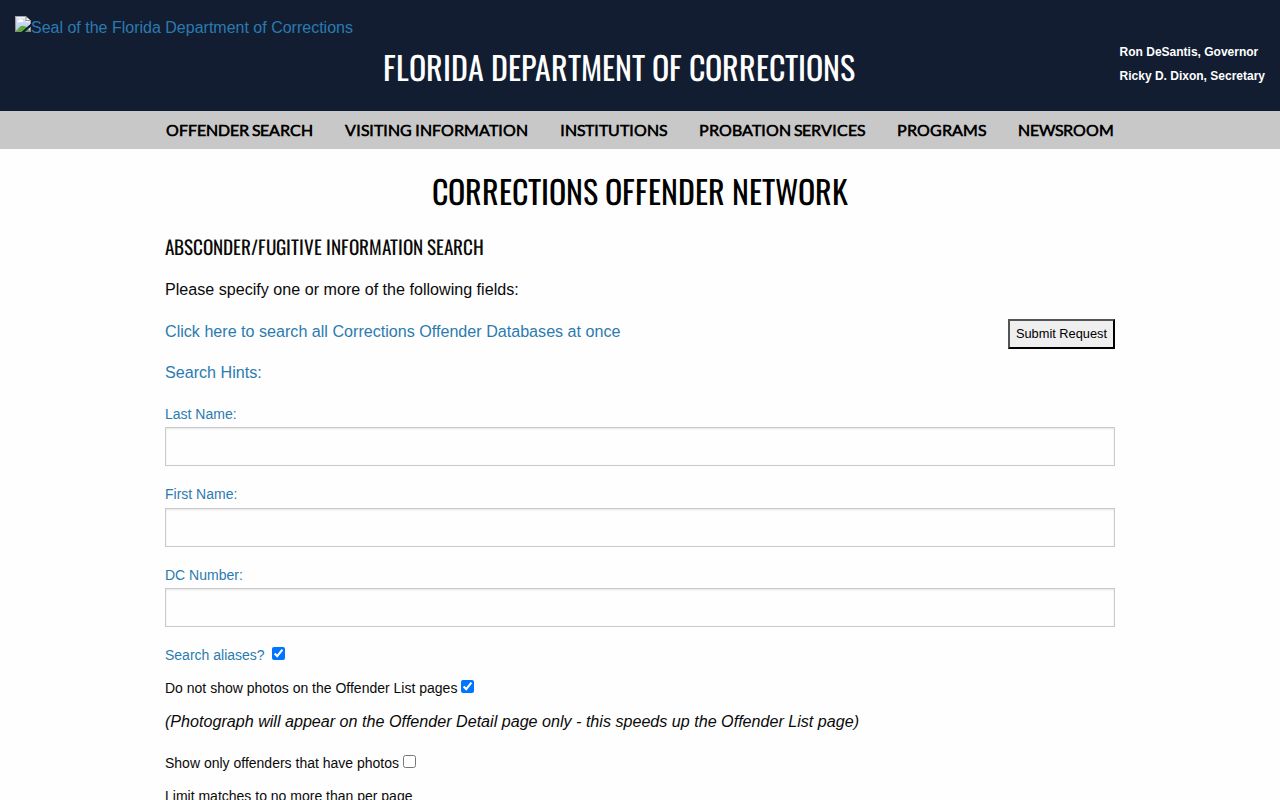
The separate screen helps prevent a wanted-supervision record from being mistaken for a normal Pasco County parole or probation discharge.
A suspected violation also does not prove that supervision has been revoked. The supervising officer may investigate, the court or Commission may issue process, and the responsible authority must make the decision its law assigns. The public record can show a filing or warrant before it shows a final outcome. For a Pasco probation case, follow the Clerk docket through the violation affidavit, hearing, and signed order. For parole or conditional release, request the FCOR action when the public agenda supplies only scheduling detail.
Conditions are case-specific. They may address reporting, travel, treatment, payment, or contact, but only the signed order and current officer instructions establish the actual terms. A general supervision search should be used to identify status and office, not to reconstruct private details or tell someone how to comply. When a record appears stale, contact the named agency with the DC number and case number rather than guessing from the last update.
Pasco Parole Commission Records
Florida parole reaches a much smaller population than probation. Modern Florida sentences generally do not carry parole eligibility, and older offense-date categories require a close statutory review under Florida Statutes section 947.16 and related law. FCOR administers parole interviews, presumptive parole release dates, effective release dates, conditional release matters, and revocations for people within its authority.
The FCOR voting schedule links dated agendas. Entries may list a DC number, county, offense, case number, category, and whether a panel or full Commission will act. An agenda proves that a matter was scheduled. It does not prove the result. A written outcome may establish, affirm, or modify a presumptive date; authorize or delay an effective release date; schedule another interview; vacate an order; or revoke release.
When the agenda is not enough, use the FCOR public-records request route, email fcorlegal@fcor.state.fl.us, or call (850) 848-4460. Pair any Commission decision with the current FDC supervision record.
Pasco Release and Reentry Support
Supervision verification can point to the correct agency, but reentry help follows a different channel. Pasco County’s Sequential Intercept Mapping report describes jail reentry planning that begins about 30 to 45 days before release for eligible sentenced people. It names BayCare or Wellpath and End Recidivism Project roles in connecting people with care and services. That timing is a program description, not a promise that every person receives the same help.
The USF Pasco Jail Reentry Project describes evidence-based treatment, case management, and reentry services and lists (813) 492-4648. These services do not set parole conditions, change a probation order, or replace an assigned officer. They can support the practical work that follows release while FDC or the court remains the source for binding supervision terms.
For the custody event that came before supervision, the Pasco County released-inmate search and release-record path explains how to pair Past Arrests with the Clerk record.
Note: Reentry staff can help with services, but only the court, FCOR, or supervising agency can change a supervision term.
Pasco Probation and Parole Discharge
Supervision ends through a documented discharge, expiration, termination, or other lawful order. A jail release date does not establish that endpoint. For court probation, the Pasco Clerk docket may show an order terminating probation, satisfaction, or a later case event. For FDC supervision, the current and historical corrections record can show status changes. For parole and conditional release, an FCOR order may be needed to explain the result.
Conditions can include reporting, travel limits, treatment, payment terms, or other case-specific duties. The signed order controls, and a general web summary should never be used to guess a person’s terms. If two records conflict, use the source closest to the fact: the court for its sentence, FCOR for its decision, and FDC for its current supervision entry. Request certified court copies when formal proof is needed.
A discharge from supervision is also not the same as sealing or expunging a criminal case. Florida sealing and expunction follow a separate court and FDLE process. Historical records can remain subject to lawful retention and access rules even after the supervision term has ended.